
Antioxidant and Antimicrobial Properties of the Essential Oil and Extracts of Vitex pseudo-negund Grown in Iran
Keywords:
Vitex pseudo-negund, antioxidant, Antimicrobial, GC-MSAbstract
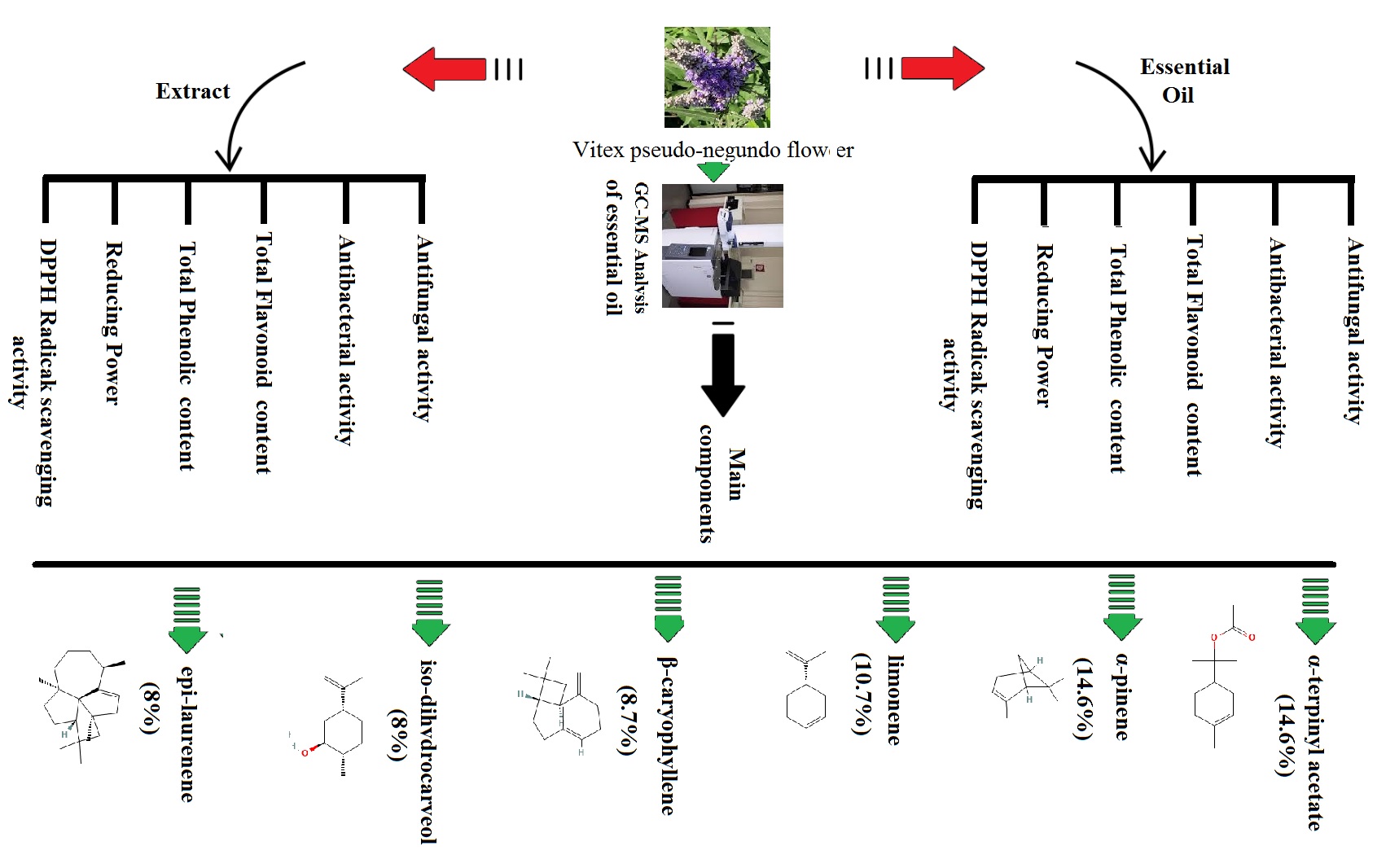
Hydrodistillation was used to obtain the essential oil of the flower of Vitex pseudo-negund. Gas chromatography (GC) and gas chromatography/mass spectrometry (GC-MS) were then used to analyze the oil. Sixty-five components, which represented 90.1 % of the oil, were characterized. The main constituents of the oil were α-pinene (14.6 %), limonene (10.7 %), iso-dihydro carveol (8%), α-terpinyl acetate (14.6 %), β-caryophyllene (8.7%), bicyclogermacrene (4.9%) and epi-laurenene (8%). In this study, the antioxidant and antimicrobial activity of Vitex pseudo-negund extract and essential oil were investigated through evaluation of antioxidant activity by DPPH and reducing power methods and the corresponding values for the antioxidant power were found to be 98.4 and 1006.6 mg/lit, respectively. The antioxidant power of the extract was higher than that of the essential oil. DPPH results were reported in terms of 50% inhibitory power (IC50). In addition, the amounts of total phenolic compounds and flavonoids of the extract were 70 mg of GAE/g and (34. mg of CE/g, respectively, while the corresponding values for the essential oil were 46.3 mg of GAE/g and 8.1 mg of CE/g, respectively. The evaluation of the antimicrobial power of the extract and essential oil showed that they both had good antimicrobial power and α-pinene and limonene, α-terpineol and Linalool had antimicrobial power.
Downloads
References
1. Lobo V, Patil A, Phatak A, Chandra N. Free radicals, Antioxidant and functional foods: Impact on human health. Pharmacogn Rev. 2010;4(8):118-126.
doi: https://doi.org/10.4103/0973-7847.70902
2. Odeh D, Kraljić K, Benussi Skukan A, Škevin D. Oxidative Stability, Microbial Safety, and Sensory Properties of Flaxseed (Linum usitatissimum L.) Oil Infused with Spices and Herbs. Antioxidants (Basel). 2021;10(5).
doi: https://doi.org/10.3390/antiox10050785
3. Karimkhani MM, Shaddel R, Khodaparast MHH, Vazirian M, Piri-Gheshlaghi S. Antioxidant and antibacterial activity of safflower (Carthamus tinctorius L.) extract from four different cultivars. Quality assurance and safety of crops & foods. 2016;8(4):565-574. doi: https://doi.org/10.3920/qas2015.0676
4. Kamal N, MioAsni NS, Rozlan INA, Mohd Azmi MAH, Mazlan NW, Mediani A, Edrada-Ebel RA. Traditional Medicinal Uses, Phytochemistry, Biological Properties, and Health Applications of Vitex sp. Plants (Basel). 2022;11(15).
doi: https://doi.org/10.3390/plants11151944
5. Safaei-Ghomi J, Meshkatalsadat M, Iran R. NANO scale injection for the determination of volatile organic components of Vitex pseudo-genusofnegundo using various extraction techniques. Dig. J. Nanomater. Bios. 2010;5.
6. Shinde Y, Barwant M, Sb D. PHARMACOGNOSTIC STUDIES OF VITEX NEGUNDO LINN. FROM KALSUBAI REGION OF WESTERN GHAT. IJRSR. 2021;12:42205-42208.
doi: https://doi.org/10.24327/ijrsr.2021.1207.6047
7. Singh P, Mishra G, Jha K, Garg V, Khosa R. Chemical composition and Antimicrobial activity of essential oil of leaves of Vitex negundo Linn. (Verbenaceae). Int J ChemTech Res. 2010;2:1686-1690.
8. Mozdianfard M, Akhbari M, Batooli H. Comparative study on the antioxidant activities of the different extracts and the composition of the oil extracted by n-hexane from Iranian Vitex pseudo-negundo. Nat Prod Res. 2012;26(23):2162-2167.
doi: https://doi.org/10.1080/14786419.2011.643308
9. Meena A, Niranjan U, Meda M, Padhi M, Babu R. A review of the important chemical constituents and medicinal uses of Vitex genus. Asian Journal of Traditional Medicines. 2011;6.(2).
10. Ağalar HG, Çiftçi GA, Yıldırım SU, Göger F, Kırimer N. The LC/ESI-MSMS Profiles and Biological Potentials of Vitex agnus castus Extracts. Nat Prod Commun. 2016;11(11):1655-1660.
11. Kuruüzüm-Uz A, Ströch K, Demirezer LÖ, Zeeck A. Glucosides from Vitex agnus-castus. Phytochemistry. 2003;63(8):959-964.
doi: https://doi.org/10.1016/S0031-9422(03)00285-1
12. Proestos C, Boziaris IS, Nychas GJE, Komaitis M. Analysis of flavonoids and phenolic acids in Greek aromatic plants: Investigation of their antioxidant capacity and antimicrobial activity. Food Chem. 2006;95(4):664-671.
doi: https://doi.org/10.1016/j.foodchem.2005.01.049
13. Sridhar C, Rao KV, Subbaraju GV. Flavonoids, triterpenoids and a lignan from Vitex altissima. Phytochemistry. 2005;66(14):1707-1712.
doi: https://doi.org/10.1016/j.phytochem.2005.05.008
14. Sathiamoorthy B, Gupta P, Kumar M, Chaturvedi AK, Shukla PK, Maurya R. New antifungal flavonoid glycoside from Vitex negundo. Bioorg Med Chem Lett. 2007;17(1):239-242.
doi: https://doi.org/10.1016/j.bmcl.2006.09.051
15. Bello MO, Zaki AA, Aloko S, Fasinu PS, Bello EO, Ajao UL, Oguntoye OS. The genus Vitex: An overview of iridoids as chemotaxonomic marker. Beni-Suef Univ J Basic Appl Sci. 2018;7(4):414-419.
doi: https://doi.org/10.1016/j.bjbas.2017.07.004
16. Karimkhani MM, Salarbashi D, Sanjari Sefidy S, Mohammadzadeh A. Effect of extraction solvents on lipid peroxidation, antioxidant, antibacterial and antifungal activities of Berberis orthobotrys Bienert ex C.K. Schneider. Food Measure. 2019;13(1):357-367.
doi: https://doi.org/10.1007/s11694-018-9951-9
17. Gasempour HR, Shirinpour E, Heidari H. Analysis by gas chromatography-mass spectrometry of essential oil from seeds and aerial parts of Ferulago angulata (Schlecht.) Boiss gathered in Nevakoh and Shahoo, Zagross mountain, West of Iran. Pak J Biol Sci. 2007;10(5):814-817.
doi: https://doi.org/10.3923/pjbs.2007.814.817
18. Yousefi M, Gandomkar S, Habibi Z. Essential oil from aerial parts of Betonica grandiflora Willd. from Iran. Nat Prod Res. 2012;26(2):146-151. doi: https://doi.org/10.1080/14786419.2010.534992
19. Bashi DS, Fazly Bazzaz BS, Sahebkar A, Karimkhani MM, Ahmadi A. Investigation of optimal extraction, antioxidant, and antimicrobial activities of Achillea biebersteinii and A. wilhelmsii. Pharm Biol. 2012;50(9):1168-1176.
doi: https://doi.org/10.3109/13880209.2012.662235
20. Guleria S, Tiku AK, Koul A, Gupta S, Singh G, Razdan VK. Antioxidant and antimicrobial properties of the essential oil and extracts of Zanthoxylum alatum grown in north-western Himalaya. ScientificWorldJournal. 2013;2013:790580.
doi: https://doi.org/10.1155/2013/790580
21. Salarbashi D, Fazly Bazzaz BS, Karimkhani MM, Sabeti Noghabi Z, Khanzadeh F, Sahebkar A. Oil stability index and biological activities of Achillea biebersteinii and Achillea wilhelmsii extracts as influenced by various ultrasound intensities. Industrial Crops and Products. 2014;55:163-172.
doi: https://doi.org/10.1016/j.indcrop.2014.01.044
22. de Souza VR, Pereira PA, da Silva TL, de Oliveira Lima LC, Pio R, Queiroz F. Determination of the bioactive compounds, antioxidant activity and chemical composition of Brazilian blackberry, red raspberry, strawberry, blueberry and sweet cherry fruits. Food Chem. 2014;156:362-368.
doi: https://doi.org/10.1016/j.foodchem.2014.01.125
23. Karimkhani Mm, Salarbashi D, Sanjari Sefidy S, Mohammadzadeh A. Effect of extraction solvents on lipid peroxidation, antioxidant, antibacterial and antifungal activities of Berberis orthobotrys Bienert ex C.K. Schneider. Food Measure. 2018;13:357-367
24. Meir S, Kanner J, Akiri B, Philosoph-Hadas S. Determination and Involvement of Aqueous Reducing Compounds in Oxidative Defense Systems of Various Senescing Leaves. J. Agric. Food Chem. 1995;43(7):1813-1819.
doi: https://doi.org/10.1021/jf00055a012
25. Nezafat Z, Karimkhani MM, Nasrollahzadeh M, Javanshir S, Jamshidi A, Orooji Y, Shokouhimehr M. Facile synthesis of Cu NPs@Fe3O4-lignosulfonate: Study of catalytic and antibacterial/antioxidant activities. Food and Chemical Toxicology. 2022:113310.
doi: https://doi.org/10.1016/j.fct.2022.113310
26. Zou Y, Lu Y, Wei D. Antioxidant activity of a flavonoid-rich extract of Hypericum perforatum L. in vitro. J. Agric Food Chem. 2004;52(16):5032-5039. doi: https://doi.org/10.1021/jf049571r
27. HadjMohammadi MR, Afif AA, Rezaee MB. Chemical Composition of Leaf, Flower and Fruit Oil of Vitex pseudo-negundo (Hausskn.) Hand.-Mzt. From Iran. Journal of Essential Oil Research. 2006;18(3):308-309.
doi: https://doi.org/10.1080/10412905.2006.9699098
28. Tayebee R, Filekesh E, Amani V. Study of the oil constituents extracted from leaf, flower and gramineous stipes of Vitex pseudo-negundo. Asian Journal of Chemistry. 2007;19:1772-1776.
29. Tang Y, Chen G, Zhang J, Mu SZ. Chemical Composition and the Regional Effect of Vitex negundo Linn. var. cannabifolia (Sieb. et Zucc.) Hand.-Mazz. Essential oils and the Regional Effect on it. Journal of the Chemical Society of Pakistan. 2011;33:744-746.
30. Hamid A, Usman L, Adebayo SA, Zubair M, Elaigwu SE. Chemical constituents of leaf essential oil of north-central nigerian grown Vitex Agnus-castus. Adv. Environ. Biol. 2010;4:250-253.
31. Zheng W, Wang SY. Antioxidant Activity and Phenolic Compounds in Selected Herbs. J. Agric Food Chem. 2001;49(11):5165-5170.
doi: https://doi.org/10.1021/jf010697n
32. Barreira JCM, Ferreira ICFR, Oliveira MBPP, Pereira JA. Antioxidant activities of the extracts from chestnut flower, leaf, skins and fruit. Food Chem. 2008;107(3):1106-1113.
doi:https://doi.org/10.1016/j.foodchem.2007.09.030
33. Wang CY, Chen YW, Hou CY. Antioxidant and antibacterial activity of seven predominant terpenoids. International Journal of Food Properties. 2019;22(1):230-238.
doi:https://doi.org/10.1080/10942912.2019.1582541
34. Zengin H, Baysal AH. Antibacterial and antioxidant activity of essential oil terpenes against pathogenic and spoilage-forming bacteria and cell structure-activity relationships evaluated by SEM microscopy. Molecules. 2014;19(11):17773-17798.
doi: https://doi.org/10.3390/molecules191117773
35. Miliauskas G, van Beek TA, de Waard P, Venskutonis RP, Sudhölter EJR. Identification of Radical Scavenging Compounds in Rhaponticum carthamoides by Means of LC-DAD-SPE-NMR. J. Nat. Prod. 2005;68(2):168-172.
doi: https://doi.org/10.1021/np0496901
36. Burt S. Essential oils: their antibacterial properties and potential applications in foods—a review. International Journal of Food Microbiology. 2004;94(3):223-253.
doi: https://doi.org/10.1016/j.ijfoodmicro.2004.03.022
37. Cushnie TP, Lamb AJ. Antimicrobial activity of flavonoids. Int J Antimicrob Agents. 2005;26(5):343-356.
doi: https://doi.org/10.1016/j.ijantimicag.2005.09.002
38. Kotzekidou P, Giannakidis P, Boulamatsis A. Antimicrobial activity of some plant extracts and essential oils against foodborne pathogens in vitro and on the fate of inoculated pathogens in chocolate. LWT. 2008;41(1):119-127. doi: https://doi.org/10.1016/j.lwt.2007.01.016
39. Guimarães AC, Meireles LM, Lemos MF, Guimarães MCC, Endringer DC, Fronza M, Scherer R. Antibacterial Activity of Terpenes and Terpenoids Present in Essential Oils. Molecules. 2019;24(13).
doi:https://doi.org/10.3390/molecules24132471
40. Teneva D, Denkova-Kostova R, Goranov B, Hristova-Ivanova Y, Slavchev A, Denkova Z, Kostov G. Chemical composition, antioxidant activity and antimicrobial activity of essential oil from Citrus aurantium L zest against some pathogenic microorganisms. Z Naturforsch C J Biosci. 2019;74(5-6):105-111.
doi: https://doi.org/10.1515/znc-2018-0062
41. Odoom JF, Aboagye CI, Acheampong P, Asiamah I, Darko G, Borquaye LS. Chemical Composition, Antioxidant, and Antimicrobial Activities of the Leaf and Fruit Essential Oils of the West African Plum, Vitex doniana. Journal of Chemistry. 2023;2023:9959296.
doi: https://doi.org/10.1155/2023/9959296
42. Sarikurkcu C, Arisoy K, Tepe B, Cakir A, Abali G, Mete E. Studies on the antioxidant activity of essential oil and different solvent extracts of Vitex agnus castus L. fruits from Turkey. Food Chem Toxicol. 2009;47(10):2479-83.
doi: https://doi.org/ 10.1016/j.fct.2009.07.005.

Downloads
Published
Submitted
Revised
Accepted
Issue
Section
License
Copyright (c) 2025 Zohreh Abdi-moghadam, Davoud Salarbashi , Mohammad Mahdi Karimkhani , Javad Asili, Bibi Sedigheh Fazly Bazzaz, Umaima Alhoqani, Elham Fahmideh Rad, Samane Attaran Dowom (Author)

This work is licensed under a Creative Commons Attribution-NonCommercial 4.0 International License.